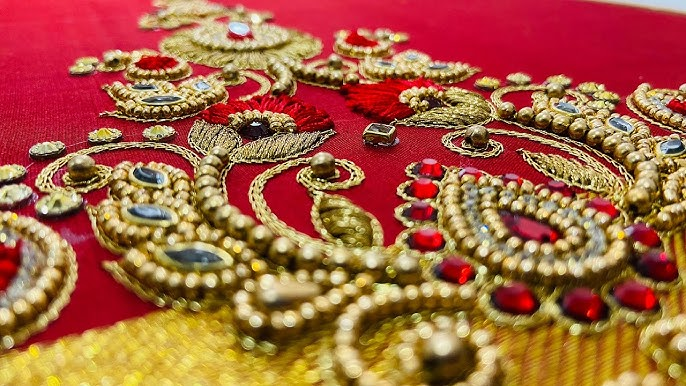
Once adorned by the royalties of the country, on the sheen of silk and the softness of velvet, the designs always would stand out like a peacock on a rainy day. Of Persian Aari Embroidery motifs enthralling the costumes and wares creating a luster of luxury and elegance, the art of aari embroidery, zari and zardosi has come a long way, since its royalty days.
Walking through the narrow streets of the old city and Juhapura areas of Ahmedabad, one comes across men and women, chit chatting on their porches around the wooden frames, while their hands speak a language of their own.
Aari embroidery is largely practiced in Ahmedabad, through various organisations such as the Mahila Vividh Laxi Odhyogik Sahakari Mandli Ltd, that employees close to 100 craftsmen working from their households. Artisan Shahid Ansari who has inherited the skill from his forefathers, practices this craft from past 22 years. His family was invited by the Navab of Banaskantha, Gujarat to practice ‘kasab’ in royal interest.
Looking at each of these distinct patterns of work, they are created with precision and a method best known to their artisans. The Aari embroidery, a celebrated and much adored work of Gujarat, requires not just the perfect stitch but also the understanding of the innate technique by which it is created. The thread is held with a finger at the reverse of the fabric and the aari, an awl-like needle with a sharp point, is held on the top.
aari-work-tools
The aari is pierced through the cloth and the thread is brought to the upper side and used to secure the previous stitch. This unique stitch, similar to the cobbler’s stitch, is repeated until the desired form is created on the surface of the fabric. The best pieces of fabrics used for this embroidery are often silk or a locally made satin called Gajji. Atlash, a special silk-satin is also used for the purpose.
aari-work-marodi-kaam1
Dotted with bootis of various shapes and sizes, motifs and designs of peacocks, flowers, these embroidered sarees, suits, dupattas and traditional Gujarati ghagra-cholis find themselves to be the centre of attention for the women across the world.Whereas, the roots of this art in India go as deep as the time of the Rig Veda , it prospered during the Mughal Emperor, Akbar. And with this, came the Persian influence, which we see in the motifs, materials and the nomenclature today.
aari-work-silk-zari
Zari, a special gold/silver thread, is often used for aari embroidery. A fine hook needle is used to make quick chain stitches with the zari. The artisan needs to not only manoeuver the needle with a rapid hand but also make sure that this pace is withheld and is kept standard for picking the material and meshing with the fabric.
aari-work-technique
Patterns cannot be directly created on to the fabrics. First, a complete and clear pattern has to be drawn on a butter paper, designing the same is done by a naksha naviz, who only helps in creating a unique pattern. The paper is then perforated along the lines of the pattern and placed on top of the fabric. Next, the artisans, using chalk, rub the pattern over the fabric, imprinting the required design. Once this has been done, around six to seven craftsmen take a portion of the fabric and start the process of embroidering the zari, using a wooden frame called the “Hadda”, “karchop” or “Khatli”- in Gujarati.


Leave a Reply